When I was a kid, I remember my dad used to quote a line from a radio show that he listened to as a kid – “Who knows what evil lurks in the hearts of men?” With no offense intended to The Shadow (the name of that radio show), I think our Lord is the only one who truly knows that. Even though I know mentally and from the Bible that all humans are way short of the glory of God and even though I am aware of horrors that have occurred at the hands of humans historically, I still find myself astonished and horrified.
Most recently, I have been grieving for the people of Iran. In the past two days, the protests were given a face in the person of young Neda Soltan. Neda had just gotten out of her car during a traffic jam caused by a protest rally. In the next moment she was shot through the heart and died in the arms of her friend and piano teacher. She wasn’t throwing rocks; she wasn’t shouting. But someone put her in the sights of his scope and pulled the trigger. What evil inside a heart allows that?
I know such evil exists, but somehow when it occurs in a specific instance and I am confronted with that specific consequence, I find myself sickened. This particular instance has gained worldwide attention, but there are tens of thousands of equally horrible things being done constantly. Sometimes in the name of religion, sometimes in the name of “national security,” sometimes simply because the perpetrator has the power.
Only God knows what evil lurks in the hearts of men, and only God is able to do anything about it. This event is just a stark reminder to me of the need of the world for God and for His ultimate sacrifice in Jesus, who took the consequences of evil onto Himself in order to allow our hearts to overcome it. It takes that level of cosmic power to deal with the depth of evil that could train its sights on a young woman for no cause but to take her life and instill fear and hatred. May God somehow use the tragedy taking place now in Iran to enable His message of love to reach the people. I pray for workers willing to go take that message.
Tuesday, June 23, 2009


Saturday, May 23, 2009
Valuing Uniqueness
This entry formulated in my head as I attended my daughter’s high school graduation. In the speeches by the principal, students, and others, several times they alluded to this high school being “the best high school in the nation.” In addition, there was high emphasis on individual success, on this class being the best yet,” “making their mark,” being leaders, etc. In talking about their children, parents usually focus on their achievements (grades, club leadership, athletic achievements). Children are steeped in this sort of emphasis from the day they are born.
As I reflected on this, it hit me how much uniqueness is a high value in our culture. Uniqueness is a prerequisite for meaning – and not just uniqueness, but uniqueness in comparison with anyone else. This brand of uniqueness is expressed in the language of superlatives. I have to be that leader, my organization or group is the best, I have to make the most impact. The unstated corollary is that my uniqueness is defined with respect to how I measure up to other people. One who cannot lay claim to this understanding of uniqueness is considered a loser. Perhaps having lived in another culture has made me more acutely aware of this trait in my own culture. I’m not ready to judge this as a fully evil trait - it could well be that it is the driver of some of our culture's economic and political strength. But how does it impact our understanding of the basis of our value as humans?
I often hear the same type of talk in the churches and in missions. I can’t help but wonder how it might blind us to the real implications of servanthood and of dying to self that are the Kingdom values Jesus hammers on in the Scriptures. Our value comes in our relationship to God; our meaning is found in Him – not in attending the greatest school in the country, or living in the strongest nation in the world, attending the church with the best worship anywhere, or sending the most missionaries. It’s hard to hear the Biblical command to “die to self” when self is constantly being propped up with the myth of uniqueness.
So I am very proud of my daughter in her graduation, but I’m thinking perhaps my focus should be more on the character that she has developed than on grades and achievements or on whether or not her school was indeed, the best high school in the nation.
As I reflected on this, it hit me how much uniqueness is a high value in our culture. Uniqueness is a prerequisite for meaning – and not just uniqueness, but uniqueness in comparison with anyone else. This brand of uniqueness is expressed in the language of superlatives. I have to be that leader, my organization or group is the best, I have to make the most impact. The unstated corollary is that my uniqueness is defined with respect to how I measure up to other people. One who cannot lay claim to this understanding of uniqueness is considered a loser. Perhaps having lived in another culture has made me more acutely aware of this trait in my own culture. I’m not ready to judge this as a fully evil trait - it could well be that it is the driver of some of our culture's economic and political strength. But how does it impact our understanding of the basis of our value as humans?
I often hear the same type of talk in the churches and in missions. I can’t help but wonder how it might blind us to the real implications of servanthood and of dying to self that are the Kingdom values Jesus hammers on in the Scriptures. Our value comes in our relationship to God; our meaning is found in Him – not in attending the greatest school in the country, or living in the strongest nation in the world, attending the church with the best worship anywhere, or sending the most missionaries. It’s hard to hear the Biblical command to “die to self” when self is constantly being propped up with the myth of uniqueness.
So I am very proud of my daughter in her graduation, but I’m thinking perhaps my focus should be more on the character that she has developed than on grades and achievements or on whether or not her school was indeed, the best high school in the nation.

Thursday, May 7, 2009
Schedule Disruptions – God’s Planning
I am on the plane, returning from a packed trip that included a visit with my daughter Rebekah in Scotland, then a field visit to our team in Kazakhstan, where my family had served from 1996-2006. When scheduling this trip, I found the best fare I could get was by buying separate round trip tickets – Atlanta-Istanbul, Istanbul-Astana (Kaz). So to see Rebekah, I delayed the departure to Kazakhstan and bought yet a third round trip fare Istanbul to Edinburgh. I saved money, but my trip to Edinburgh ended up being a 31-hour trip, complete with four plane changes! I don’t recommend you hire me to do your travel planning.
After buying the tickets so they all lined up, Turkish Air changed the schedule which resulted in us having to spend an unplanned full day in Istanbul. I was frustrated as that shortened our trip to Kazakhstan and it meant the expense of an overnight. As I was planning, I remembered that one of the young women from the student ministry in Kazakhstan was now in Istanbul for Hodgkins Lymphoma treatment. Lyuba is a sweet, bubbly young woman who I had gotten to know the 2-3 years prior to our leaving Kazakhstan in 2006. So I wrote her to see if she’d like to get together.
I ended up being able to see her mother in Kazakhstan so she could give me some stuff to bring. She is understandably concerned about her daughter and it was good to be able to console her and to be her courier. It was fun to see what a Russian in Istanbul misses – the care package included pickled fish, a packet of Russian mayonnaise, dark bread, porridge mix, and some of that fake crab meat. Lyuba was very excited to get it!
Yesterday I spent nearly 3 hours with Lyuba. She was glad to have a chance to speak Russian, as she has been living with an American missionary family in Turkey for 5 months. We had a delightful visit which I think was a blessing and encouragement to her. And she was ecstatic about the care package from her mother!
As we went our separate ways, I thought about how if Turkish Air had not changed the schedule, it would not have been possible to have this time together. Did God orchestrate this? I don’t know. But I do know that He wants us keep our eyes open for ministry opportunities, especially in the midst of interruptions, and that He will use us even when things happen that we really had not intended or even wanted.
After buying the tickets so they all lined up, Turkish Air changed the schedule which resulted in us having to spend an unplanned full day in Istanbul. I was frustrated as that shortened our trip to Kazakhstan and it meant the expense of an overnight. As I was planning, I remembered that one of the young women from the student ministry in Kazakhstan was now in Istanbul for Hodgkins Lymphoma treatment. Lyuba is a sweet, bubbly young woman who I had gotten to know the 2-3 years prior to our leaving Kazakhstan in 2006. So I wrote her to see if she’d like to get together.
I ended up being able to see her mother in Kazakhstan so she could give me some stuff to bring. She is understandably concerned about her daughter and it was good to be able to console her and to be her courier. It was fun to see what a Russian in Istanbul misses – the care package included pickled fish, a packet of Russian mayonnaise, dark bread, porridge mix, and some of that fake crab meat. Lyuba was very excited to get it!
Yesterday I spent nearly 3 hours with Lyuba. She was glad to have a chance to speak Russian, as she has been living with an American missionary family in Turkey for 5 months. We had a delightful visit which I think was a blessing and encouragement to her. And she was ecstatic about the care package from her mother!
As we went our separate ways, I thought about how if Turkish Air had not changed the schedule, it would not have been possible to have this time together. Did God orchestrate this? I don’t know. But I do know that He wants us keep our eyes open for ministry opportunities, especially in the midst of interruptions, and that He will use us even when things happen that we really had not intended or even wanted.
Tuesday, April 28, 2009
Connecting Worlds
I am writing this while in the airport in Kazakhstan with missionary Joyce Chellis and her son Travis. Travis is leaving after his 2-week visit to his mother. It’s his first time to visit the place that has been home to his mother for nearly 13 years now. We had a nice chat on the way here about his experience. He said it sort of “gives a face” to what his mother has been doing. He had heard her stories, seen pictures, read letters. But now he can connect her life with his own experiences here.
This makes me mindful of one of the difficulties for the missionary that may catch a person by surprise. When you live some where for an extended period of time, it becomes an important part of your life. People become dear friends and the list of shared experiences grows in the place of ministry. And yet there are also friends and family back in the home country with a list of shared experiences. So the missionary and the missionary kids (MKs) feel in a way that they exist in two totally distinct worlds.
With our own family, we saw how our children eagerly desired that there would be connections between the worlds. The first time that their grandparents met some of the other members of our team on home leave in the US was a huge blessing. Finally the two worlds had at least some connection. I remember when Sherry Waid, a friend from our home church in Kentucky, came to visit us two years into our life in Kazakhstan. She experienced our life and met our friends. It was a huge blessing for us to have the connection and it created a bond with her that continues on today 10 years later, even though we don’t often have a chance to see one another.
So I’m wrapping this up as Joyce says “bye” to Travis, knowing now that when she speaks of the people and village she has grown to love, he will have a greater connection to this important part of her life. That will be a blessing to both of them that will now be shared for the rest of their lives.
This makes me mindful of one of the difficulties for the missionary that may catch a person by surprise. When you live some where for an extended period of time, it becomes an important part of your life. People become dear friends and the list of shared experiences grows in the place of ministry. And yet there are also friends and family back in the home country with a list of shared experiences. So the missionary and the missionary kids (MKs) feel in a way that they exist in two totally distinct worlds.
With our own family, we saw how our children eagerly desired that there would be connections between the worlds. The first time that their grandparents met some of the other members of our team on home leave in the US was a huge blessing. Finally the two worlds had at least some connection. I remember when Sherry Waid, a friend from our home church in Kentucky, came to visit us two years into our life in Kazakhstan. She experienced our life and met our friends. It was a huge blessing for us to have the connection and it created a bond with her that continues on today 10 years later, even though we don’t often have a chance to see one another.
So I’m wrapping this up as Joyce says “bye” to Travis, knowing now that when she speaks of the people and village she has grown to love, he will have a greater connection to this important part of her life. That will be a blessing to both of them that will now be shared for the rest of their lives.
Sunday, April 12, 2009
A Question of Allegiance
I recently responded to an e-mail from Vince Rutherford, a good friend, supporter, and former long-time missionary to Pakistan who had some questions for reflections based on his recent reading of Paul Hiebert’s book Transforming Worldviews. (This is a book I would highly recommend for an understanding of missions). Hiebert identifies the difference in a “bounded set” approach toward thinking of the Kingdom of God as opposed to a “centered set.” The former focuses on the boundary – either a person is “in” or they are “out.” This is the most common approach the church has taken to the question of salvation. However, Hiebert argues that the more Biblical approach is a “centered set” where the focus is on the Kingdom center – Jesus Christ. A person is either moving toward that center or moving away. Whether or not there is a boundary becomes less the issue.
Vince repeated Hiebert’s question: “Can a village person become a follower of Jesus after only a very basic hearing of the gospel story?” Vince followed with his own musings: “I am wondering about the many people around the world who have heard a bit and have begun to pray in Jesus name for help in their problems. Are they ‘in the Kingdom’ even though they are only near the edge?”
I believe Hiebert was right on with the distinction between bounded and centered sets - as a math major, I like his use of those concepts! When one begins to understand that distinction, then it certainly does challenge all sorts of assumptions of what it means to be "in" or "out" - even those words themselves fall short of being good descriptors.
I believe for the final question, we have only to look at the Scriptures. Did the Samaritan woman, the man possessed by legion, the thief on the cross, etc have sufficient information to be considered a "follower of Jesus?" What they had was a real encounter with Jesus - not a propositional confession. That encounter was sufficient for them to shift their allegiance to Christ. I've found that speaking of allegiance to or alignment with Christ is more in line with Kingdom thinking than the more limited terms we tend to use when thinking of personal salvation. Certainly "born again" and "saved" are Biblical images - but they are not the exclusive ones that are used. They just fit more with the bounded set approach, so as children of the Enlightenment and modernism, we've tended to focus more on them at the exclusion of other images.
What this way of thinking does is really free us from assuming the burden of being the judge. It really is not (nor never has been) my responsibility to determine who is in and who is out. My responsibility is live my life in such a way that people will be introduced to Christ and have a genuine encounter with Him, such that there is a changing of their allegiance. Then in community, we work through the implications of this shift of allegiance on our lives. Our tools for that are His Word, the guidance of the Spirit, the community of faith, and (giving away my ecclesiology) the community of faith through the ages.
Vince repeated Hiebert’s question: “Can a village person become a follower of Jesus after only a very basic hearing of the gospel story?” Vince followed with his own musings: “I am wondering about the many people around the world who have heard a bit and have begun to pray in Jesus name for help in their problems. Are they ‘in the Kingdom’ even though they are only near the edge?”
I believe Hiebert was right on with the distinction between bounded and centered sets - as a math major, I like his use of those concepts! When one begins to understand that distinction, then it certainly does challenge all sorts of assumptions of what it means to be "in" or "out" - even those words themselves fall short of being good descriptors.
I believe for the final question, we have only to look at the Scriptures. Did the Samaritan woman, the man possessed by legion, the thief on the cross, etc have sufficient information to be considered a "follower of Jesus?" What they had was a real encounter with Jesus - not a propositional confession. That encounter was sufficient for them to shift their allegiance to Christ. I've found that speaking of allegiance to or alignment with Christ is more in line with Kingdom thinking than the more limited terms we tend to use when thinking of personal salvation. Certainly "born again" and "saved" are Biblical images - but they are not the exclusive ones that are used. They just fit more with the bounded set approach, so as children of the Enlightenment and modernism, we've tended to focus more on them at the exclusion of other images.
What this way of thinking does is really free us from assuming the burden of being the judge. It really is not (nor never has been) my responsibility to determine who is in and who is out. My responsibility is live my life in such a way that people will be introduced to Christ and have a genuine encounter with Him, such that there is a changing of their allegiance. Then in community, we work through the implications of this shift of allegiance on our lives. Our tools for that are His Word, the guidance of the Spirit, the community of faith, and (giving away my ecclesiology) the community of faith through the ages.
Thursday, April 2, 2009
The Thrill of Discovery
A few of us are out here in California attending training in experiential learning and facilitation. Yesterday we got to practice our newly acquired skills on some college kids at a low ropes course. At the final debrief, one of the gals in my group said it was so neat how I didn't seem to have an agenda, but simply asked questions and allowed them to think through the issues for themselves, rather than giving them answers or even forcing them into certain answers.
It was so interesting to see how it worked. As our instructor encouraged us, to "trust the process." I was surprised how much discipline it took on my part to listen to the young people and tailor my next question or comment based on what they were saying, rather than thinking so hard about where I wanted to go that I didn't even hear them. Yet I found with patience and true listening, the insights they came up with were as good or better than content I could have delivered. Their excitement of discovery was enormously higher than if they had just received content from me. And the cool thing was that my enjoyment of hearing them come up with these insights actually was higher than the enjoyment of delivering the info myself.
It is good to be reminded that the One who had all knowledge spent three years giving teachings in the form of parables and often in the form of questions. Talk about content! He could have spent all three years lecturing and still not covered half his content. But instead, He lead the disciples (and us) on a journey of discovery. So often we forget this as we consider training and discipleship.
It was so interesting to see how it worked. As our instructor encouraged us, to "trust the process." I was surprised how much discipline it took on my part to listen to the young people and tailor my next question or comment based on what they were saying, rather than thinking so hard about where I wanted to go that I didn't even hear them. Yet I found with patience and true listening, the insights they came up with were as good or better than content I could have delivered. Their excitement of discovery was enormously higher than if they had just received content from me. And the cool thing was that my enjoyment of hearing them come up with these insights actually was higher than the enjoyment of delivering the info myself.
It is good to be reminded that the One who had all knowledge spent three years giving teachings in the form of parables and often in the form of questions. Talk about content! He could have spent all three years lecturing and still not covered half his content. But instead, He lead the disciples (and us) on a journey of discovery. So often we forget this as we consider training and discipleship.
Friday, March 20, 2009
A Different World
I am writing from a conference in Bangkok Thailand. It's been an intense week of teaching, discussions, and meetings. Knowing all of us would have mental fatigue, the organizers left Wednesday afternoon free. So 4 other guys and I headed to the river. Well, we had good intentions of going to the nearest point on the river, but the little tuk tuk (like a little motercycle/tricycle used to transport people) driver had other ideas. What should have been a short 5-minute drive ended up being an hour all the way across town. Anyhow, we made it to the river. We decided to take a Thai longboat ride. These boats are so cool - they are long (go figure) with a high, pointed prow. There is a huge engine in the back well above the water with a long propeller. The driver moves the propellor in and out of the water and side to side to steer - there is no rudder.
He took us through several canals around the city. We saw parts of the city that you could see no other way. Houses right up on the canal or on stilts in bordering marshes with no road going to them. We realized we were seeing an entire subculture that probably exists quite separate from the busy city-life of Bangkok. People on little coracles, paddling around getting fish or collecting plants. One place looked like a village built totally on a marsh - all the houses on stilts, no roads anywhere. At one house, I saw a little girl no more than three on the veranda - no railing and the water below. I guess living there, having the water all around is just part of life. So we'd see kids playing in places that any landlubbing parent would freak out about!
Very interesting to see a totally different way of living. Our funniest was the "floating market" - which ended up being an elderly man on a little canoe-like boat floating up to us and offering various trinkets and beer.
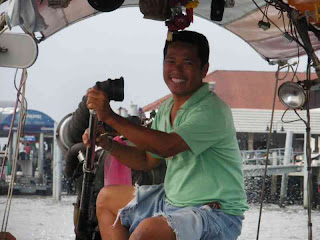


He took us through several canals around the city. We saw parts of the city that you could see no other way. Houses right up on the canal or on stilts in bordering marshes with no road going to them. We realized we were seeing an entire subculture that probably exists quite separate from the busy city-life of Bangkok. People on little coracles, paddling around getting fish or collecting plants. One place looked like a village built totally on a marsh - all the houses on stilts, no roads anywhere. At one house, I saw a little girl no more than three on the veranda - no railing and the water below. I guess living there, having the water all around is just part of life. So we'd see kids playing in places that any landlubbing parent would freak out about!
Very interesting to see a totally different way of living. Our funniest was the "floating market" - which ended up being an elderly man on a little canoe-like boat floating up to us and offering various trinkets and beer.


Subscribe to:
Posts (Atom)

